Research Summary
In my class, you practiced writing a short research summary for every source you read. A different class may not use the term "research summary," and an instructor may call the pieces something else, or ask for them in a different order. But if a class asks you to describe a study in your own words, you are being asked to do the same five jobs. This page reviews those five parts, then gives you a new example to practice on.
Read Critically First
Before you can write any of the five parts below, you have to find them in the text. That means reading critically rather than just absorbing information: interpreting it, categorizing it, questioning it, and weighing its value.
One way to do this is to look for golden lines: a standout sentence or key concept that grabs your attention, impacts your thinking, or sparks a deep reaction. A golden line is often where the text
- raises a question for you,
- confirms what you've found in other sources,
- makes you say "aha,"
- conflicts with another article, or
- causes you to reconsider an assumption.
As you mark golden lines, sort them: is this one the main claim? Evidence? A theme? A limitation or perspective? That sorting is exactly what turns a highlighted article into a research summary.

The Five Parts of a Research Summary
- Full citation and source type. Who wrote it, when, and what kind of source it is (study, review, book, or report).
- Main claim or purpose. One sentence: what the source set out to show or argue.
- Key evidence or findings. For a study, this is the design and the main result.
- Theme and connection to other sources. What broader idea this source speaks to, and whether it agrees or disagrees with other work.
- Limitation or perspective. One honest note on what the source does not tell you, such as a small sample or a single site.
Limitation or Perspective?
The fifth part isn't always a limitation. Sometimes that's not the right fit for a source, and naming the author's perspective works better instead. Either one is an honest, non-critical way to describe the source's boundaries.
Either way, you're not criticizing the source. You're answering: What doesn't this source tell us? Who or what wasn't included? From what viewpoint is the author writing? Every source has boundaries — naming one builds your credibility, it doesn't undercut the source.
Worked Example
Here is a research summary from HDFS 301. Click each sentence to see which job it is doing. Found: 0 / 5
Try It Yourself
Here is a new summary, written the same way but on a different topic. For each piece, choose which of the five jobs it is doing.
1. "Using survey data from 342 middle school students and their parents, the researchers found that adolescents who described their parents as authoritative reported significantly lower anxiety scores than those who described authoritarian or permissive parenting."
2. "Because the study relied on adolescent self-report collected at a single point in time, it cannot show whether parenting style causes lower anxiety or merely co-occurs with it."
3. "Chen and Alvarez (2022) examined how parenting style relates to anxiety symptoms in early adolescents."
4. "This finding connects to a theme on parenting practices and emotional regulation and aligns with earlier work linking parental warmth and structure to lower adolescent distress."
Why Summarize First?
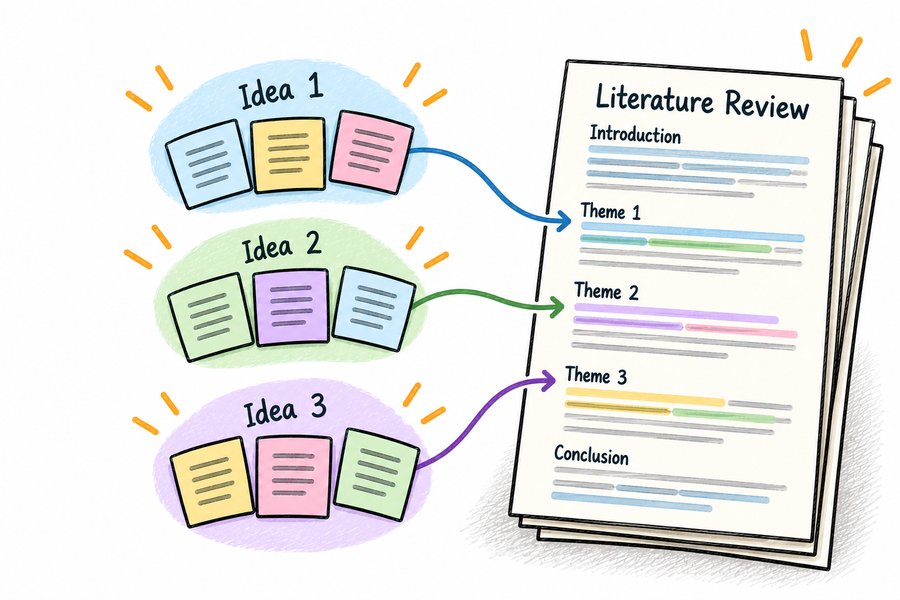
A paper is not just a stack of summaries — but summaries are the raw material it's built from. Once you've written one for each source, you group sources that share an idea, and those groups become the themes of your literature review.
This is also why summary and synthesis are different steps: a summary focuses on one source and is written during research; synthesis connects multiple sources and is written during drafting. Doing the summaries first is what makes synthesis possible later.